Holcomb, Kansas
In Cold BloodHolcomb, Kansas, is the prairie village whose ordinary isolation is ruptured by the murders at River Valley Farm. Its broad, open landscape and close-knit habits first establish a community seemingly far from extraordinary events; afterward, the town’s familiar homes and streets become the setting for fear, suspicion, public spectacle, and enduring memories of the Clutter family.
Setting and Community
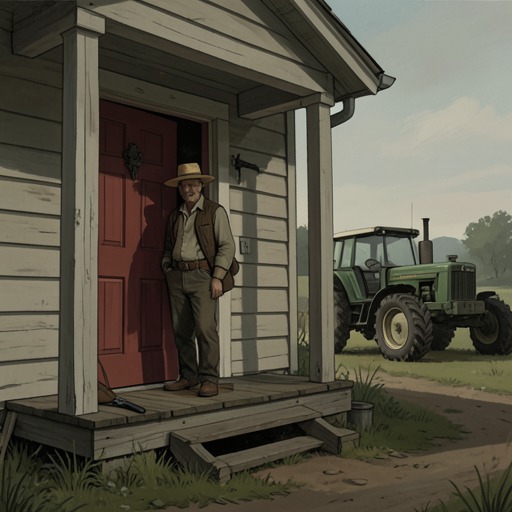
Holcomb stands on the high wheat plains of western Kansas, about seventy miles east of the Colorado border. Its hard blue skies and clear air make the region feel more like the Far West than the Midwest. The land is flat and the views extend so far that horses, cattle, and the town’s grain elevators appear long before travelers arrive. The village itself is a modest collection of buildings, divided by the main-line tracks of the Santa Fe Railroad, bounded by the Arkansas River to the south and Route 50 to the north, with prairie and wheat fields stretching east and west. The town’s streets are unnamed, unpaved, and unshaded; rain and thaw turn their dust to mud. A former dance hall stands dark, and the Holcomb Bank, closed in 1933, has been converted into apartments. Most homes are one-story frame houses with porches. Against this plain built environment, the Holcomb School stands out: a modern consolidated school serving kindergarten through senior high, with buses carrying about 360 students from as far as sixteen miles away. The school reflects a prosperous agricultural district whose residents raise cattle and sheep and grow wheat, milo, grass seed, and sugar beets. Natural-gas resources also contribute to local prosperity, visible in comfortable farmhouses and enlarged grain elevators. Before the murders, Holcomb’s 270 residents lived within familiar routines of work, hunting, school events, choir practice, and 4-H meetings. The landscape’s openness did not make the village prominent; until November 1959, few people outside the region had heard of it. Its distance from larger centers, the railroad, and the highway framed a life that seemed ordinary and self-contained.
River Valley Farm and the Rupture
The Clutter family’s River Valley Farm belongs to the rural landscape around Holcomb, but its importance is not merely geographic. The family represented qualities the community valued, and the murders there shattered the assumption that a settled, prosperous household was secure. In the opening account, the sounds of the crime are set against the village’s usual nighttime noises: coyotes, tumbleweed, and distant trains. At the time, sleeping residents heard nothing; afterward, those same sounds and the imagined return of the violence became part of the town’s shared memory. The next morning’s ordinary routines briefly continued around the farm. Holcomb lies twelve miles east of the mountain-time-zone border, so in winter the sky could still be dark at the hour of early chores. Two sons of Vic Irsik completed their Sunday work without noticing anything amiss. Later, Nancy Ewalt arrived with her father, Clarence Ewalt, as she customarily did so that she could accompany the Clutter family to church in Garden City. When repeated attempts at several entrances brought no response, she noticed that both family cars were in the garage, tried the remaining doors, and returned to her father. The routine visit and the unremarkable explanation that the family might still be asleep sit close to the discovery of what had happened, heightening the contrast between familiar Sunday habits and the crisis at the farm.
Fear and Suspicion
After the killings, Holcomb’s social atmosphere changed. Beforehand, residents had so little reason to fear one another that they seldom bothered to lock their doors. Now people repeatedly imagined the violence happening again, and neighbors who had known one another for years began to view each other with suspicion. Many believed that the person responsible must live nearby. The community’s distress arose not only from fear of another attack but from the collapse of confidence in its own familiar relationships. The fear became visible in the town’s houses. Colorado pheasant hunters passing through Holcomb at dawn found windows lit across nearly every home and families still awake, fully dressed and listening through the night. Local residents explained their vigilance by the possibility that the crime could recur. Hardware-store customers bought locks and bolts without much concern for the brand; what mattered was that they might hold. Protection became a new household concern in a place where open doors had previously seemed natural. Myrtle Clare, Holcomb’s widowed postmistress, stood apart from the prevailing anxiety. She dismissed the fear as timidity and maintained her usual confidence. Eleven months later, masked bandits invaded the post office and took $950, an episode that gave her earlier bravado a grim afterlife. Her experience underscores that the danger in the book does not remain confined to the original crime or to the Clutter home: even the town’s most defiant resident is eventually confronted by violence.
Public Attention and the Farm’s Afterlife
The murders brought outsiders into a place that had rarely attracted attention. In January, the return of the accused men drew a large crowd to the courthouse square in Garden City, rather than to Holcomb itself. Reporters and spectators gathered there to watch them arrive and be taken to the county jail. The distinction matters: Holcomb was the location of the crime and the community’s disruption, while the neighboring city became the stage for the prisoners’ public return and legal custody. In mid-March, the Clutter farm itself drew an immense gathering for its auction. Slightly more than 5,000 people attended, far exceeding the turnout at a nearby farm sale earlier in the year and making it the largest auction crowd in western Kansas history. Cars arrived from across the state and from Oklahoma, Colorado, Texas, and Nebraska. For the first time since the murders were discovered, the public could visit the property. Some came to bid, while others came out of curiosity; visitors also approached the uninhabited house and peered through its windows. The auction thus turned a working farm into both a sale site and a place of public remembrance, where the ordinary business of disposing of an estate coexisted with fascination and unease.
Memory and Continuity
Holcomb’s later life does not erase what happened. When Susan Kidwell, home briefly from the University of Kansas, discusses the possibility that the town’s streets may be paved, the prospect of change is small beside the memory she carries. She recalls that she and Nancy Clutter had planned to attend college together and share a room. Her account joins an ordinary conversation about Holcomb’s future to a future that was imagined but never reached. The village remains a lived-in place, with residents who leave for school and return home; it is also a landscape in which earlier hopes remain attached to the people and places that held them. The town’s narrative significance lies in this tension. Holcomb begins as a remote but materially comfortable farming community, and its ordinary geography and routines make the murders’ effects legible: familiar neighbors become objects of suspicion, homes become places of watchfulness, and River Valley Farm passes from private workplace and home to crime scene and auction ground. The prairie remains wide and open, but the community’s experience of safety does not return to its former simplicity.